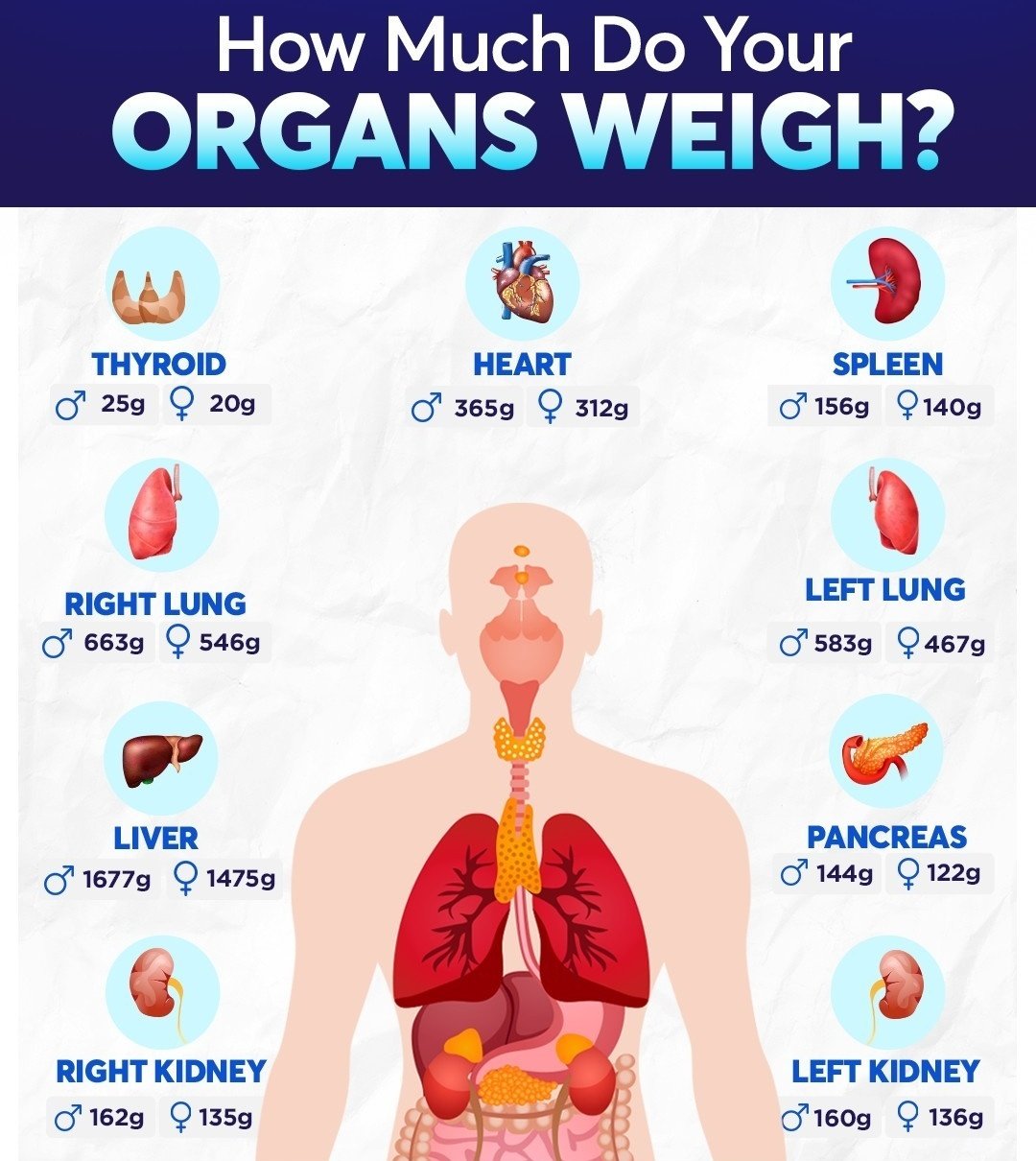
Human Body Organs and Their Average Weights
Updated adult reference values for the brain, heart, lungs, liver, kidneys, spleen, pancreas, blood, skeletal muscle, skin and other body components—with important corrections for competitive exams.
Human organ weights are approximate reference values, not fixed constants. They can vary with sex, age, height, body weight, population, health status and measurement method.
Why Do Human Organ Weights Vary?
Tables showing the “weight of every human organ” are popular in General Science and competitive-examination material. However, many online tables present the numbers as though every healthy adult has exactly the same organ weight.
That is scientifically incorrect.
Studies of normal adult organs show considerable variation between individuals. Important factors include:
- Sex
- Age
- Height and body size
- Body weight
- Population and geographic background
- Disease or health status
- Living measurement vs post-mortem measurement
Values such as:
Head = 4.5–5 kg
Stomach = 1–1.5 kg when full
Intestines = 1.5–2 kg
Skeleton = 10–12 kg
should not be memorised as standard adult organ weights.
The head is not a single organ, stomach weight changes enormously with its contents, intestinal contents vary, and skeletal mass depends heavily on body size and how it is measured.
Most Important Human Organ Weights – Quick Recall
Human Body Organs and Their Approximate Weights
The internal-organ figures below use published adult reference studies, including an Indian autopsy study conducted at AIIMS Rishikesh.
| S.No. | Organ / Body Component | Approximate Adult Reference | Important Exam / Science Note |
|---|---|---|---|
| 1 | Brain |
Male: ≈1,313 g Female: ≈1,218 g |
AIIMS Rishikesh adult autopsy averages. Brain weight varies with sex, age and body size. |
| 2 | Heart |
Male: ≈310 g Female: ≈241 g |
Healthy heart weight varies substantially with body size, sex and cardiac condition. |
| 3 | Right Lung |
Male: ≈499 g Female: ≈408 g |
Normally heavier than the left lung in the Indian reference study. |
| 4 | Left Lung |
Male: ≈460 g Female: ≈369 g |
The left lung is generally smaller because the heart occupies part of the left thoracic cavity. |
| 5 | Both Lungs Together |
Male: ≈959 g Female: ≈777 g |
Calculated from the right and left lung averages reported in the same Indian study. |
| 6 | Liver |
Male: ≈1,477 g Female: ≈1,309 g |
The liver is the largest internal solid organ in the human body. |
| 7 | Spleen | ≈150–160 g | AIIMS Rishikesh averages were about 154 g in men and 156 g in women. |
| 8 | Right Kidney |
Male: ≈126 g Female: ≈108 g |
Adult kidney size and weight vary with body size and sex. |
| 9 | Left Kidney |
Male: ≈126 g Female: ≈107 g |
The two kidneys are similar but are not necessarily exactly equal in weight. |
| 10 | Both Kidneys Together |
Male: ≈252 g Female: ≈215 g |
Approximate combined value from AIIMS Rishikesh data. |
| 11 | Pancreas | ≈90–100 g | Published adult autopsy studies report averages around 97 g in men and 88 g in women in one population. |
| 12 | Blood | ≈70 mL/kg in a normal-weight adult | A 70-kg adult would therefore have roughly 4.9 litres of blood. It is better expressed as volume than “organ weight.” |
| 13 | Skeletal Muscle | Roughly 30–40% of body mass | MRI research reported averages around 38.4% in men and 30.6% in women. Training, age and sex substantially affect muscle mass. |
| 14 | Skin / Integument | Often described as ≈15% of body weight | This depends strongly on what layers and associated tissues are included. Avoid treating “3–5 kg” as a universal value. |
| 15 | Adipose Tissue / Body Fat | No single normal weight | Fat mass varies greatly with sex, age, genetics, nutrition, physical activity and total body composition. |
Important: The values above are educational approximations. Autopsy organ weights are not identical to in-vivo organ mass, and reference values differ between populations and studies.
Indian Reference Study – AIIMS Rishikesh
A 2022 study from the Department of Forensic Medicine and Toxicology at AIIMS Rishikesh examined adult organ weights after excluding organs with significant histological abnormalities.
The study included 137 adult autopsies: 104 males and 33 females.
| Organ | Male Mean | Female Mean |
|---|---|---|
| Brain | 1,313.2 g | 1,218.0 g |
| Heart | 310.1 g | 241.2 g |
| Right Lung | 499.4 g | 407.5 g |
| Left Lung | 459.6 g | 369.4 g |
| Liver | 1,477.0 g | 1,309.0 g |
| Spleen | 154.0 g | 156.0 g |
| Right Kidney | 125.9 g | 108.1 g |
| Left Kidney | 126.3 g | 106.6 g |
Do not memorise the decimal values.
Remember approximately: Brain ≈1.2–1.3 kg
Heart ≈250–300 g
Liver ≈1.3–1.5 kg
Each kidney ≈100–130 g
Spleen ≈150 g
Brain – Important Facts
The adult human brain commonly weighs around 1.2–1.4 kg, although there is considerable normal variation.
In the AIIMS Rishikesh study, the mean was approximately 1.31 kg in males and 1.22 kg in females.
Brain → about 1.3 kg
Heart – Important Facts
The adult heart generally weighs a few hundred grams rather than kilograms.
In the Indian reference study, average values were approximately:
- Male → 310 g
- Female → 241 g
Heart weight may increase in conditions such as cardiac hypertrophy, hypertension and other cardiovascular diseases.
Liver – Largest Internal Solid Organ
The liver is the largest internal solid organ in the human body.
A useful exam approximation is:
The AIIMS Rishikesh averages were approximately 1.48 kg in males and 1.31 kg in females.
How Much Blood Is in the Human Body?
Blood is better described by volume rather than by a fixed weight.
A widely used estimate for normal-weight adults is approximately:
| Body Weight | Approximate Blood Volume at 70 mL/kg |
|---|---|
| 50 kg | ≈3.5 L |
| 60 kg | ≈4.2 L |
| 70 kg | ≈4.9 L |
| 80 kg | ≈5.6 L |
Actual blood volume varies with body composition, sex, pregnancy, fitness and other factors.
How Much of the Human Body Is Skeletal Muscle?
Skeletal muscle is one of the largest tissue compartments in the human body.
A whole-body MRI study of 468 adults found average skeletal muscle mass of:
- 33.0 kg in men – approximately 38.4% of body mass
- 21.0 kg in women – approximately 30.6% of body mass
Skeletal muscle → roughly 30–40% of adult body mass
Important Corrections to Common Internet Tables
| Old Claim | Updated Understanding |
|---|---|
| Head = 4.5–5 kg | The head is not a single organ. It contains skull, brain, muscles, skin, blood, eyes and other tissues. There is no single standard “head weight” for anatomy GK. |
| Stomach = 1–1.5 kg when full | This mainly reflects the amount of food and fluid inside the stomach, not the weight of the stomach organ. |
| Intestines = 1.5–2 kg | Intestinal weight varies with length, tissue, hydration and contents. It is not a useful fixed competitive-exam figure. |
| Skeleton = 10–12 kg | Skeletal and bone mass varies substantially by age, sex and body size. Modern body-composition measurements also distinguish bone mineral content from total skeletal tissue mass. |
| Body Fat = 15–25% | Body-fat percentage has wide normal biological variation and differs by sex and age. It should not be treated as a universal “healthy adult” range for all people. |
| Blood = exactly 5 litres | Better approximation: about 70 mL/kg in normal-weight adults. |
Human Body Static GK Booster
| Question Point | Answer |
|---|---|
| Largest organ of human body | Skin |
| Largest internal solid organ | Liver |
| Largest gland | Liver |
| Approximate brain weight | ≈1.2–1.4 kg |
| Approximate heart weight | ≈250–300 g |
| Approximate liver weight | ≈1.3–1.5 kg |
| Approximate kidney weight | ≈100–130 g each |
| Approximate spleen weight | ≈150 g |
| Approximate pancreas weight | ≈90–100 g |
| Approximate adult blood volume | ≈70 mL/kg |
| Skeletal muscle contribution | Roughly 30–40% of body mass |
Easy Memory Trick
Brain → ≈1.3 kg
Heart → ≈300 g
Liver → ≈1.4 kg
Kidney → ≈120 g each
Spleen → ≈150 g
Pancreas → ≈100 g
Do Not Confuse
| Term 1 | Term 2 | Difference |
|---|---|---|
| Largest Organ | Largest Internal Organ | Skin = largest organ; Liver = largest internal solid organ. |
| Organ Weight | Body Component Percentage | Heart or liver can be weighed directly; muscle and body fat are usually discussed as body-composition compartments. |
| Blood Weight | Blood Volume | Blood is normally discussed clinically in litres or mL/kg rather than as a fixed kilogram value. |
| Stomach Organ Weight | Full Stomach Weight | A “full stomach” measurement includes food and fluid and is therefore highly variable. |
10 Exam-Focused MCQs
Choose an answer. The correct answer and explanation will appear automatically.
1. What is the approximate weight of an adult human brain?
The AIIMS Rishikesh averages were approximately 1.31 kg in males and 1.22 kg in females.
2. The approximate adult heart weight is closest to:
Heart weight varies considerably with sex and body size.
3. Which is the largest internal solid organ in humans?
The liver is the largest internal solid organ and also the largest gland.
4. The approximate weight of one adult kidney is:
Published adult averages generally fall in this region, although individual variation is substantial.
5. The approximate weight of an adult pancreas is:
6. Approximately how much blood would a 70-kg normal-weight adult have using the 70 mL/kg estimate?
70 kg × 70 mL/kg = 4,900 mL = 4.9 litres.
7. Which is the largest organ of the human body?
Skin is considered the body's largest organ.
8. Skeletal muscle accounts for approximately what fraction of adult body mass?
Muscle mass differs significantly between individuals.
9. Why is “stomach weighs 1–1.5 kg when full” a poor standard organ-weight fact?
A “full stomach” measurement includes variable food and liquid contents and does not represent the organ alone.
10. Which statement about human organ weights is scientifically correct?
Reference studies demonstrate substantial normal biological variation in organ weights.
Quick Revision – 15 Must-Remember Points
- Adult brain → approximately 1.2–1.4 kg.
- Adult heart → approximately 250–300 g.
- Liver → approximately 1.3–1.5 kg.
- Liver is the largest internal solid organ.
- Skin is the largest organ.
- Right lung is generally heavier than the left lung.
- Each kidney weighs approximately 100–130 g.
- Both kidneys together are roughly 200–250 g.
- Spleen → approximately 150 g.
- Pancreas → approximately 90–100 g.
- Normal-weight adult blood volume is approximately 70 mL/kg.
- A 70-kg adult therefore has approximately 4.9 L of blood.
- Skeletal muscle makes up roughly 30–40% of body mass.
- Organ weights differ between men and women and across populations.
- Do not treat internet “organ weight” numbers as universal biological constants.
Frequently Asked Questions
What is the average weight of the human brain?
A useful adult approximation is around 1.2–1.4 kg. An Indian AIIMS Rishikesh study reported averages of about 1.31 kg in males and 1.22 kg in females.
How much does the human heart weigh?
A useful exam approximation is about 250–300 g, although actual weight varies with sex, body size and health.
How much does the liver weigh?
The adult liver commonly weighs approximately 1.3–1.5 kg.
What is the largest organ in the human body?
The skin is the largest organ of the human body.
What is the largest internal organ?
The liver is the largest internal solid organ and the largest gland.
How much blood does an adult human have?
A useful estimate for normal-weight adults is about 70 mL/kg. Therefore, a 70-kg adult would have approximately 4.9 litres.
Do all adults have the same organ weights?
No. Organ weights vary with sex, age, height, body mass, population, health and measurement method.
Scientific Sources and References
- Vaibhav V, et al. – Adult Organ Weights, AIIMS Rishikesh, Uttarakhand, India
- Updating Normal Organ Weights Using a Large Current Dataset
- Normal Organ Weights in Adult Men – Brain, Lungs, Liver, Spleen and Kidneys
- Study of Normal Internal Organ Weights – Pancreas and Other Organs
- Blood Volume Estimation in Adults
- Skeletal Muscle Mass and Distribution in Adult Men and Women
- Structure and Function of Human Skin
This post has been revised using published anatomical, forensic and body-composition research.
The major change from the old post is that organ weights are now presented as approximate adult reference values rather than universal fixed numbers.
Conclusion
Human organ weights are useful for Biology, General Science, Anatomy and competitive-exam revision, but students should remember that these measurements are approximate.
The safest exam values to remember are:
Heart → ≈250–300 g
Liver → ≈1.3–1.5 kg
Kidney → ≈100–130 g each
Spleen → ≈150 g
Pancreas → ≈90–100 g
Blood → ≈70 mL/kg
Skeletal Muscle → ≈30–40% of body mass
Most importantly, remember: organ weights vary naturally and should never be treated as identical values for every human being.
Educational Disclaimer: These are approximate adult educational reference values, not diagnostic limits. Clinical and forensic interpretation requires age-, sex-, body-size- and population-appropriate reference data.
Comments
Post a Comment