
RBI Polymer Banknotes: ₹10 and ₹20 Notes Approved for Field Trials
A clear, student-focused explanation of India’s proposed plastic currency notes, their legal basis, trial quantity, advantages, limitations, history and important exam facts.
RBI to Introduce Plastic Currency Notes in India: Complete Explanation
India has taken an important preliminary step towards introducing polymer banknotes, commonly described as plastic currency notes. The approved proposal covers the ₹10 and ₹20 denominations. These notes will first be tested to understand their durability, public handling, security, suitability for Indian climatic conditions and overall performance. The development is important for students preparing for UPSC, APPSC, TSPSC, SSC, Railway, Banking, Police and other Government examinations because it connects current affairs with the RBI Act, currency management, monetary institutions, banknote security and the Indian economy.
Why Are RBI Polymer Banknotes in the News?
In a written reply in the Lok Sabha, the Government informed Parliament that the RBI had proposed the introduction of one billion pieces each of ₹10 and ₹20 polymer banknotes for field trials. The proposal was made with the recommendation of the RBI’s Central Board and was submitted to the Central Government under the legal framework governing the design, form and material of Indian banknotes.
The Government has approved the proposal. However, the approval represents the beginning of a testing and evaluation process rather than an immediate nationwide launch. Regular issuance of polymer notes in these denominations is expected to be considered only after the trials are completed successfully. As of 28 July 2026, no definite date has been officially announced for the general public to receive the new notes.
The Government has also clarified that there is no proposal to completely replace India’s existing paper-substrate banknotes with polymer notes. Polymer and paper notes are intended to coexist. Therefore, citizens should not believe social-media messages claiming that existing ₹10 or ₹20 paper notes will suddenly become invalid.
The RBI has informed the Government that international studies indicate that polymer banknotes generally have a significantly longer lifespan than conventional paper banknotes. Longer-lasting notes may reduce how frequently worn-out currency has to be withdrawn, destroyed and replaced. Nevertheless, their final usefulness in India will depend on field-trial results, production security, machine compatibility, public response and end-of-life recycling.
Official RBI Images of the Existing ₹10 and ₹20 Notes
The following RBI educational posters show the security features of the existing paper-based Mahatma Gandhi New Series notes. They do not show the final design of the proposed polymer notes. As of the date of this update, the final public design of the polymer trial notes has not been officially released through these posters.
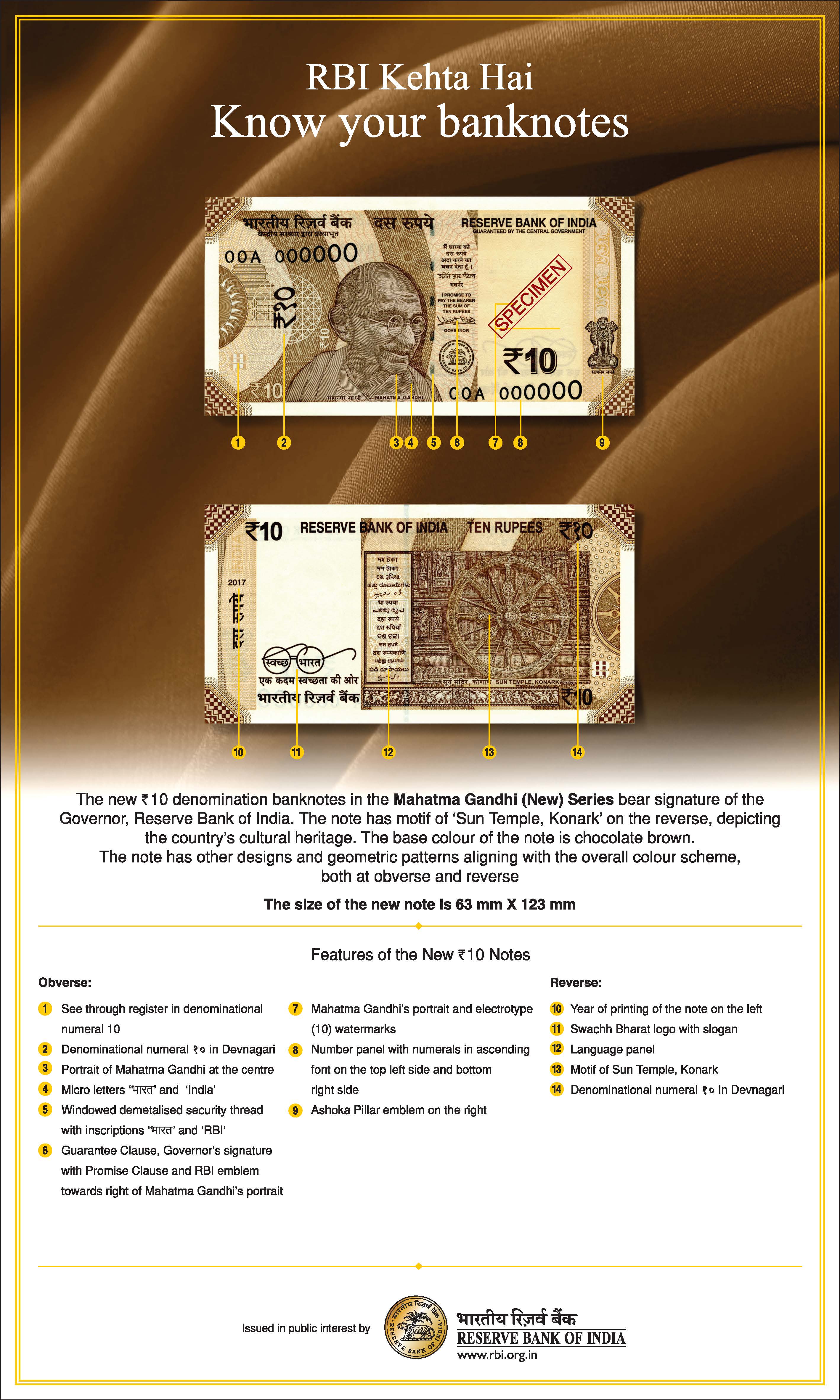
Existing ₹10 Mahatma Gandhi New Series banknote and its security features.
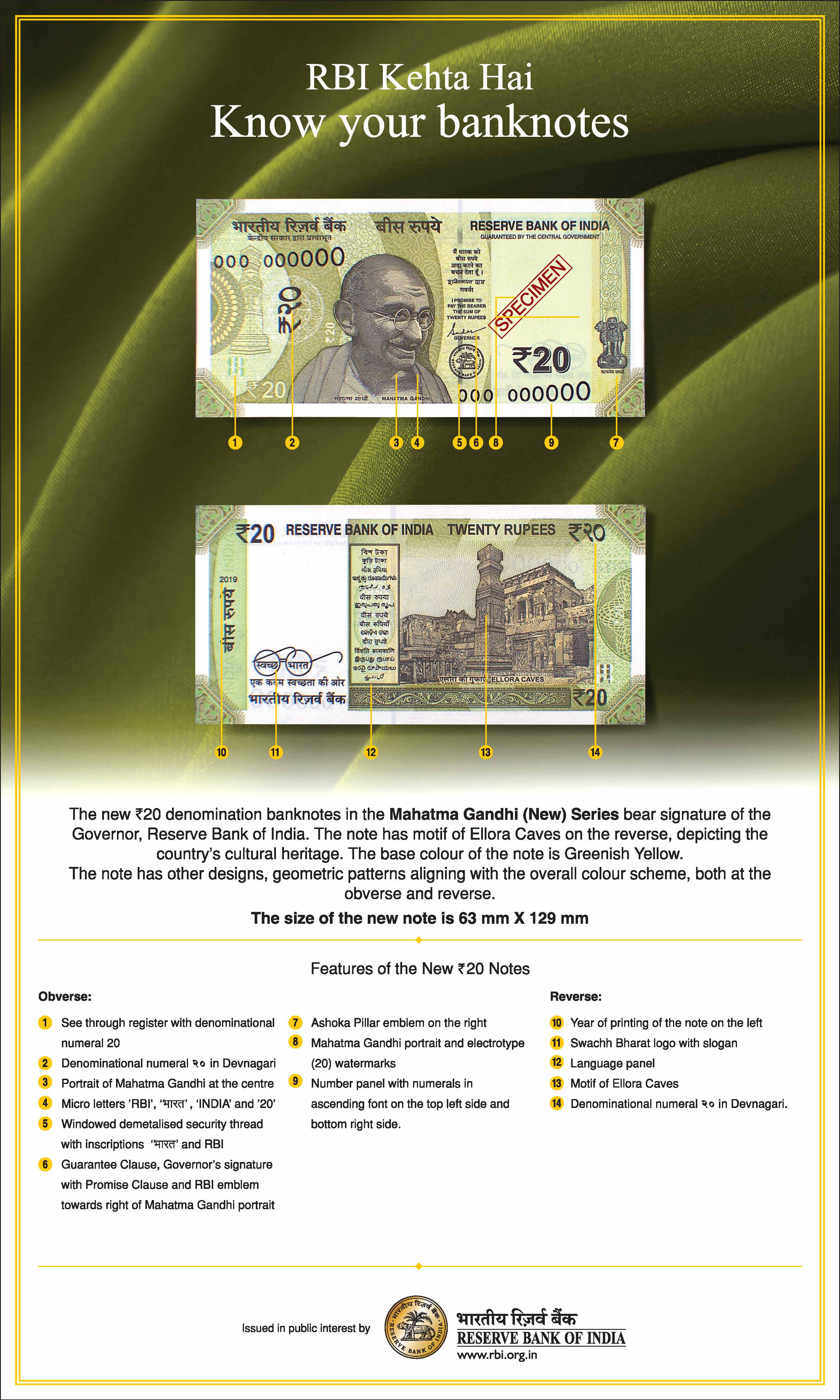
Existing ₹20 Mahatma Gandhi New Series banknote and its security features.
What Is a Polymer Banknote?
A polymer banknote is a currency note printed on a specially manufactured synthetic polymer substrate instead of conventional banknote paper. The term “plastic note” is commonly used for easy understanding, although the substrate is a carefully engineered security material rather than ordinary household plastic.
Polymer substrates are generally non-fibrous and non-porous. They can be designed with clear or transparent windows, holographic elements, specialised inks, tactile features and other anti-counterfeiting technologies. The exact features of India’s proposed polymer notes will become clear only when the RBI officially releases their design and security specifications.
The RBI’s currency FAQ states that the paper currently used for printing Indian banknotes is made using 100% cotton. Therefore, India’s present notes should not be described as ordinary wood-pulp paper. This is an important competitive-examination clarification.
Polymer Notes vs Existing Indian Banknotes
| Feature | Polymer Banknote | Existing Indian Banknote |
|---|---|---|
| Basic substrate | Special synthetic polymer film | Banknote paper made using 100% cotton |
| Structure | Generally non-fibrous and non-porous | Fibrous cotton-based material |
| Water resistance | Generally more resistant to water and moisture | More capable of absorbing moisture and dirt |
| Expected lifespan | International studies indicate a longer circulation life | May require replacement more frequently after heavy use |
| Security possibilities | Can include transparent windows and advanced optical features | Uses watermark, security thread, microprinting and other features |
| Indian status in July 2026 | Approved for ₹10 and ₹20 field trials | Already in regular circulation |
| Legal status | Will depend on official RBI issuance and notification | Existing legal-tender status continues |
How Will the Polymer Note Process Work?
Legal Basis: Section 25 of the RBI Act, 1934
The introduction of a new banknote material is not decided by the RBI alone. The Reserve Bank of India Act, 1934 establishes a defined legal process. Under Section 25, the design, form and material of banknotes must be approved by the Central Government after it considers the recommendations made by the RBI Central Board.
| RBI Act Provision | Important Exam Point |
|---|---|
| Section 22 | The RBI has the sole right to issue banknotes in India, subject to the Act. |
| Section 24 | Deals with the denominational values of banknotes. |
| Section 25 | Design, form and material require Central Government approval after RBI Central Board recommendation. |
| Section 26 | Deals with the legal-tender character of banknotes and the Central Government guarantee. |
Why Were ₹10 and ₹20 Chosen?
Lower-denomination notes are frequently used for small everyday transactions. They may pass through many hands and experience folding, moisture, dust, staining and general wear. India’s earlier polymer-banknote proposals also focused on improving the life of lower-denomination notes.
Testing ₹10 and ₹20 notes can help the authorities study whether a polymer substrate performs better in high-use denominations without initially changing the entire banknote system. The trials can also provide information about public acceptance, counting-machine performance, storage, transportation, recycling and production costs.
Possible Advantages of Polymer Currency Notes
1. Longer Circulation Life
Polymer notes are expected to remain usable for a longer period, reducing the frequency with which damaged notes must be replaced.
2. Moisture and Dirt Resistance
Their non-porous surface generally makes them more resistant to water, sweat, stains and ordinary dirt.
3. Advanced Security Features
Transparent windows, optical effects and specialised security elements can make authentication easier and counterfeiting more difficult.
4. Lower Replacement Frequency
A longer useful life may reduce repeated printing, transportation, sorting and destruction of unfit notes.
Challenges and Questions That Field Trials Must Examine
- Initial cost: Polymer substrates may cost more to procure and print initially.
- Indian climate: Notes must perform under heat, humidity, monsoon conditions, dust and intensive handling.
- Machine compatibility: ATMs, counting machines, vending machines and sorting equipment may require testing or calibration.
- Public handling: Authorities must study folding, slipperiness, creasing and ease of use.
- End-of-life management: A secure and environmentally responsible recycling or disposal process will be required.
- Security: Polymer is not automatically impossible to counterfeit; effective security features and continuous upgrades remain necessary.
India’s Earlier Polymer Banknote Plans
| Year | Development | Exam Importance |
|---|---|---|
| 2012 | The Government announced a decision to introduce one billion ₹10 polymer notes on a field-trial basis in five cities. | The main objective was to increase the life of lower-denomination notes. |
| 2013 | Kochi, Mysore, Jaipur, Bhubaneswar and Shimla were named for trials because of their varied geographical and climatic conditions. | Remember the five-city climatic-diversity approach. |
| 2017 | A Parliamentary reply stated that approval for procurement of plastic substrate and printing of ₹10 trial notes had been conveyed to the RBI. | The proposal remained under official consideration and preparation. |
| 2026 | The Government approved one billion pieces each of ₹10 and ₹20 polymer notes for field trials, followed by regular issuance after successful completion. | This is the latest and most important current-affairs update. |
Important Clarifications for Students and the Public
| Claim or Confusion | Correct Explanation |
|---|---|
| All Indian paper currency will soon be cancelled. | Incorrect. The Government says there is no proposal to completely replace paper currency. |
| The ₹10 and ₹20 polymer notes are already available everywhere. | Incorrect. The proposal is in the preliminary field-trial phase. |
| A nationwide launch date has been fixed. | No definite public-launch date had been officially announced as of 28 July 2026. |
| Two billion notes means currency worth ₹2 billion. | No. It means two billion individual note pieces, or 200 crore notes. |
| Existing Indian banknote paper is ordinary wood paper. | Incorrect. RBI states that the present banknote paper is made using 100% cotton. |
| Plastic money always means debit or credit cards. | The expression is context-dependent. In this topic, it refers to physical polymer banknotes. |
| Digital payments will replace cash because of this decision. | The Government describes currency notes and digital payment systems as complementary payment tools. |
Static GK Connections
| Topic | Important Fact |
|---|---|
| Central Bank | Reserve Bank of India |
| RBI Establishment | 1 April 1935 |
| Governing Law | Reserve Bank of India Act, 1934 |
| RBI Nationalisation | 1 January 1949 |
| RBI Headquarters | Mumbai, Maharashtra |
| Current RBI Governor | Sanjay Malhotra, as of 28 July 2026 |
| ₹1 Note | Issued by the Government of India and signed by the Finance Secretary |
| Other Banknotes | Issued by the RBI and bear the RBI Governor’s signature |
| Banknote Material Approval | Section 25 of the RBI Act, 1934 |
| Existing Banknote Paper | Made using 100% cotton, according to RBI |
Easy Memory Trick
Quick Revision Points
10 MCQs
Frequently Asked Questions
Has RBI officially launched ₹10 and ₹20 plastic notes?
The Government has approved the RBI proposal for field trials. This should not be confused with an immediate nationwide public launch.
Will existing ₹10 and ₹20 paper notes become invalid?
No such decision has been announced. The Government has stated that polymer notes are proposed to circulate along with paper-substrate notes.
When will polymer notes become available to the public?
No definite nationwide release date had been officially announced as of 28 July 2026. Regular issuance is linked to successful field trials.
Are polymer banknotes ordinary plastic?
No. They are printed on a specially engineered polymer security substrate designed for currency production.
Why are polymer notes important for competitive examinations?
The topic connects current affairs with the RBI Act, currency management, Section 25, banknote materials, monetary institutions, legal tender and the Indian economy.
Related Posts on Learn With Mahesh
Official Sources and References
- Akashvani News – Government approval for ₹10 and ₹20 polymer banknotes
- Reserve Bank of India – Indian Currency FAQs
- India Code – Reserve Bank of India Act, 1934
- Press Information Bureau – 2012 Polymer Banknote Field-Trial Decision
- Press Information Bureau – 2013 Plastic Currency Notes and Five Trial Cities
- Rajya Sabha – 2017 Reply on Introduction of Plastic Currency
- RBI Financial Education – Official Currency Note Posters
- RBI – Current Executives and Departments
Comments
Post a Comment